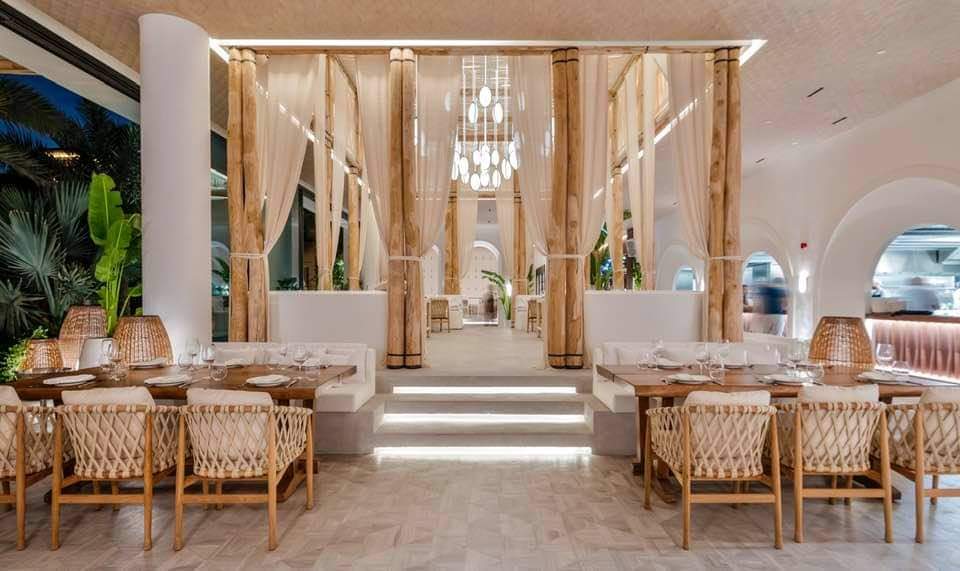
Nammos Dubai
Makrame Installation
The Nammos Dubai Makrame art project gave as the opportunity to join our forces in a team that aims to show that Greek handcrafters have brilliant ideas as well as excellent executional skills.
· 6 makramists: the top names of the Greek market
· 600 days of work
· 48.000 hours
· 3.000.000 knots all made by hand
· 80 kgr. of extra fine Greek Cotton rope
· It covers a handcrafted surface of 120 m2 using an unusually thin rope, turning the final outcome as one of the largest worldwide.
Fibers and skin in an intrinsic connection
Charis Kanellopoulou, PhD
Art historian, Curator
Macramé –textile constructions based on knotting– is one of the crafts being intensively revitalized nowadays through knotting techniques that go back in time: macramé originated in the 13th century by Arab weavers –who used decorative knot fringes to finish the excess thread of garments and everyday linen– to spread by the Moors to Spain, then to Italy, and then to the rest of Europe. In the 17th century, Queen Mary of England taught macramé classes to her ladies-in-waiting, while during the Victorian era this type of decoration became mostly popular for many household objects. In the meanwhile, sailors brought macramé knotting to China and the New World; hammocks, belts and bell fringes were the most common among their creations to be sold or exchanged at ports.
Although macramé’s popularity faded in the years to come, its resurgence occurred in the 1970s, while today’s crafters regenerate it once more, by weaving fiber decorations with traditional artisan materials that put out this art with up-to-date style.
Under this prism, the large-scale, hand-woven cotton fiber creation, which is presented at Dubai, celebrates this revival of unique handmade items, valuing the traditional crafts, but with a modern twist. In specific, the work consists of twenty macramé panels, which in their unity form a rectangle construction of wall hangings with fluid movement. Five macramé crafters, coming from different cities of Greece, co-operated during the creative process: each one of them expressed himself/herself outwardly through fiber, letting personal emotions and experience to drive the procedure of knotting. The artistic outcome resembles to a wide stage made of fabric, forming simultaneously a kind of an outdoor setup and a protective interior: when you move around it, it is as if you approach a theatre curtain, handcrafted stable yet transparent; then, when you step in the space of the fabric room, you feel like becoming part of this abundant installation, embraced by the meditative calmness, which derives from its repetitively developed patterns. Hercules’s knot is selected as the main pattern of the macramé construction: a knot made by intertwining two ropes, which was considered a healing charm in ancient Egypt, and also a protective amulet and a wedding and fertility symbol in ancient Greece and Rome, while later survived in Medieval and Renaissance tokens. For the decoration endings, the artists chose the pattern of the straw, the golden herb that reflects the union of the sun and the land, also used as a symbol of fertility and abundance.
As a whole, this macramé installation mirrors the amount of energy that is expected to be devoted during the procedure of its creation; knot-weaving is a time-consuming craft, as it is revealed by a closer observation of the numerous knots of these wall hangings, hand-woven from rope and worked with patient finger ingenuity. Next to the contemplative quality of this work lies also the purifying feeling that comes from its material: Greek cotton rope, in its natural color, activates the senses of touch and smell, bringing to the foreground the softness of the construction, in antithesis with the building’s strong architectural structure.
Self-developed virtuosity, formal invention and enduring dedication to the repetitive knot-weaving movements appear as main characteristics of a working process that requires equal involvement of the body and the mind. This macramé installation highlights this exploration; its knot patterns construct expressive forms and transfer archetypal symbols, shaped in a plain and intimate architectural space that reflects the intrinsic connection of fibers and skin.
Charis Kanellopoulou, PhD
Art historian, Curator
Comments are closed